
August 21, 2026
Gemma completes her masters project with Greyhope Bay

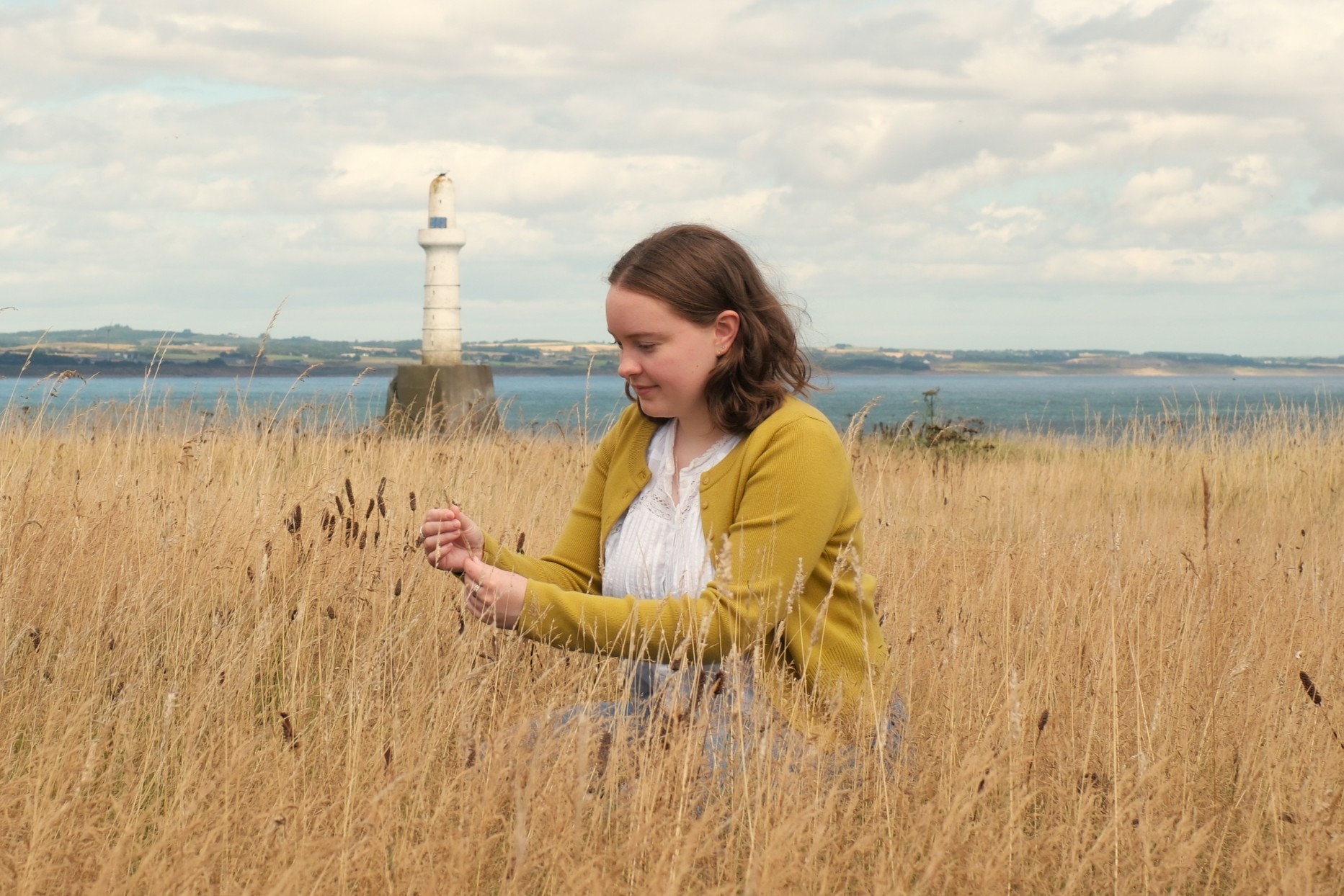
This summer we welcomed University of Glasgow’s Ecology and Environmental Monitoring MSc student Gemma, who completed her 6-week project with us. Her project brief was to research surveying methodologies with the aim of applying them to the varied habitats surrounding the Greyhope Bay Centre, and to record and better understand the site’s baseline biodiversity. Alongside her research, she also took on a variety of volunteering activities with us and attended many of our talks and workshops.
Her resulting report will be invaluable for Greyhope Bay as we progress with our Phase 2 plans, as it provides us with a thorough framework on which we can build a robust surveying programme. It also lays a solid baseline of data of biodiversity of the area, which complements our own survey and BioBlitz records nicely.
Over the 6-week period she recorded a whopping 191 species of plants, birds, insects and animals within 6 specific survey areas, including the grassland around the centre, the sandy beach by the south breakwater and the rockpools in Greyhope Bay. As she was explaining her findings, it was reassuring to learn that the habitats around the centre are currently healthy and thriving, with minimal invasive species.
With the increasing threat of cimate change, Gemma’s work also helps to inform how we shape our sustainability policies going forward, and how small charities like us can monitor and maintain thriving habitats for the future.
We have absolutely loved having her with us, and it has been wonderful seeing her become part of the Greyhope community; especially seeing her grow in confidence as she has developed and applied her knowledge not just with her own project but as a volunteer as well. We wish her all the luck with her master’s and future career!
The rich text element allows you to create and format headings, paragraphs, blockquotes, images, and video all in one place instead of having to add and format them individually. Just double-click and easily create content.
A rich text element can be used with static or dynamic content. For static content, just drop it into any page and begin editing. For dynamic content, add a rich text field to any collection and then connect a rich text element to that field in the settings panel. Voila!
Headings, paragraphs, blockquotes, figures, images, and figure captions can all be styled after a class is added to the rich text element using the "When inside of" nested selector system.


